Saturday, September 5, 2009

International Vulture Awareness Day 2009


Show me a birder who says vultures are cute, and I’ll show you a liar. 

The wrinkled, carcass-like skin on their heads probably won’t ever make me smile like an Indigo Bunting’s bright blue plumage will.  Their hunched over walk and black feathers probably won’t either.  Watching them soar overhead, while amazing in its own right, isn’t going to compete with a Peregrine Falcon’s dive or a hummingbird’s mid-air hovering act anytime soon (at least not in my book). 

Don’t overlook these scavengers, though.  They are truly wonders of evolution and are as ecologically fascinating as any other bird you will find.  Take their feather-less heads, for example.  If a scavenging bird has to stick their face into a nice, fresh deer carcass, what would be the better option?  Having a bunch of feathers that are going to collect blood, guts, infectious diseases, and potentially parasites?  Or having a head that looks like a feather-plucking machine just got a hold of them, making those big spongy primates say “ew”?  I think evolution has ignored us on this one and chosen the latter. 

A Black Vulture and Turkey Vulture share a squirrel carcass they have just removed from the road (c) 2009

Vultures also serve important ecological functions.  They consume large quantities of dead flesh;  dead flesh that would otherwise be crowding our forests, streets, and parks.  Sure, there are other scavengers and agents of decay that would eventually do their thing, but few as quickly as the vultures.  And some of these other scavengers are animals like rats and feral dogs that carry diseases and act as pests in a variety of other ways.   

Unfortunately many species of vulture are in severe decline.  “Across the Indian subcontinent, populations of three formerly very common species of vulture have declined by more than 97% as a result of consuming cattle carcasses contaminated with the veterinary drug diclofenac. There have been mass vulture deaths in East Africa associated with misuse of chemicals, huge population declines in West Africa due to habitat loss, and the disappearance of vultures from large areas of their formers ranges in South Africa because of the continued use of vulture parts in traditional medicine and sorcery.” (Source: http://birdlife.org ) 

Today, September 5th, is International Vulture Awareness Day.  Check out the official site at http://www.ivad09.org/ and get some more info about the trouble vultures are in at BirdLife .  If you have a blog, please consider participating in the event by posting about vultures.  Could be something you write, paint, photograph, draw…anything, really.  Get the button and more info here: http://www.ivad09.org/wp/ 


Tuesday, September 1, 2009

The Arrival of Autumn

While the calendar still reads summer, there are two groups of people who have already shifted into fall mode. Students, who know the end of August means the beginning of classes, and birders, who know that the second round of yearly migration doesn't wait until summer officially ends. Birds have already begun moving south to escape the cold that is quickly approaching. Shorebirds began moving last month, and now songbirds are starting to trickle through New Jersey on their way to the southern United States and the neotropics. Migratory warblers are being seen more and more, and in the coming weeks their numbers will continue to rise.

Raptors have begun to migrate as well, although the spectacle that is hawk-watching won't peak until October. It is then that thousands of raptors can be seen in a single afternoon. Hawk-watches around New Jersey, such as Chimney Rock, Raccoon Ridge, and Cape May Point State Park, offer extraordinary views of Peregrine Falcons, Broad-Winged Hawks, American Kestrels, Merlins, Bald Eagles, and even the occasional Golden Eagle.

Migration always brings some interesting and often unusual birds to the state. This week a Swallow-Tailed Kite has been viewed reliably at Wallkill National Wildlife Refuge. Although a few of these birds usually turn up in NJ each year, it's always a treat to be able to watch a kite in the Garden State.

Photograph by Derek Bakken

Baird's Sandpiper, Loggerhead Shrike, Franklin's Gull, Black Terns, and Little Stints are some other recent sightings. There are certainly more rarities to be discovered, and even more that haven't yet arrived but will shock us all when they do end up showing up.

Autumn is really an exciting time to enjoy the outdoors. Not only do you have great birding opportunities, but the weather is perfect for hiking, kayaking, or just tossing around the ol' pigskin. When the leaves turn the rich colors of the season become impossible to ignore, and it's always fun finding a great roadside market to buy some warm apple cider.

Tuesday, August 25, 2009

Meadowlands Festival of Birding

Join the NJ Audubon Society, the NJ Meadowlands Commission, and Hackensack Riverkeeper for a fun-filled weekend of birding and other festivities! There will be both field and boat birding tours, butterfly walks, a raptor presentation, a lecture by Dr. Robert DeCandido on bird migration, plus much more. On Sunday the weekend continues with paddling tours of nearby birding spots. Tickets are $40 for the two-day festival and include just about everything, including breakfast and lunch on Saturday. Check out their site here and sign up quickly! The boat and paddling tours require reservations in addition to tickets.

Friday, August 7, 2009

International Vulture Awareness Day 2009


That's right, vultures have finally received their own day in the spotlight. Check out the official IVAD09 website and join in on September 5th by blogging about vultures. That could mean photos, video, a short story about a close encounter...anything you want!

http://www.ivad09.org/wp/

Tuesday, August 4, 2009

Updates

Hey readers,

I have to apologize for the lack of updates. This past Saturday I returned from a week of birding and hiking central Panama, and next week I leave for Reno, NV. A day after I get back, I'll be driving up to Maine! And while those places have little to do directly with "New Jersey Outdoors", I should have some great photos to post here soon!

On the NJ front, banding has continued at HMF in my absence. Some new birds have been banded including Scarlet Tanager, House Wren, Carolina Wren, Hairy Woodpecker, and Red-Bellied Woodpecker.

With the breeding season drawing to a close, our hope is that this banding will continue next summer and beyond so that abundances and species composition can be monitored. Trends in these numbers will hopefully reveal causes of decline and perhaps increases in certain species of birds. With the potential control of invasive plants looming on the horizon, it will be interesting to see how that affects the bird communities of Hutcheson Memorial Forest moving forward.

The forest is a unique ecosystem for the area, and it's a great place to visit and explore. Check the website for upcoming tours at http://www.rci.rutgers.edu/~hmforest/


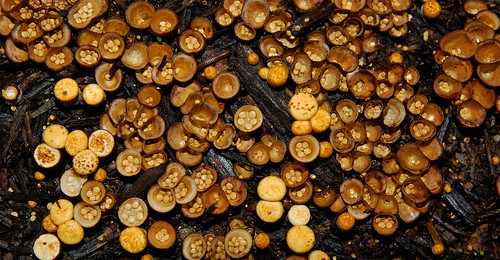
Bird's Nest Fungi


Stay tuned! Starting this fall NJ Outdoors will be commencing a Species Profile series for the different types of wildlife in the Garden State. An interview series is also in the works featuring sit-downs with prominent members of the community. Scientists, photographers, and many others with their hands in our natural world.

Tuesday, July 21, 2009

Birding & Wildlife Trails needs your help!


New Jersey's Birding & Wildlife Trails is creating a new Pinelands Guide for the state, which will include Atlantic, Burlington, Camden, and Gloucester counties. If you fill out their nomination form to help them decide on which sites to include, they will give you a FREE one-year membership to the New Jersey Audubon Society! All of the information needed can be found on the site, located here.

Monday, July 20, 2009

Brighter Planet


From the green minds of the people who brought us the 350 Challenge comes Brighter Planet! - a website designed to help people accurately and easily track their environmental impact. Enter things like your vehicle, home, and diet to find out how large your carbon footprint might be. You can also read and contribute tips on saving energy and conserving the environment. For those interested the site also makes it easy to partially or completely offset your carbon footprint!


Check out the site and help them test their beta version: http://beta.brighterplanet.com/

Add me if you decide to join. Username: Billtacular